I wrote this article for The New York Times in 2007 and I feel compelled to repost it. Hamas’ brutal massacre of men, women and children on October 7 left 1,200 dead and some 235 people dragged across the border where many of them are still being held hostage. The death toll for soldiers killed fighting ISIS-like terrorists is 225. So I was thinking of all the grieving mothers . . .
I wrote the piece a year after the Israel-Hezbollah War in 2006. . . And sadly, there might be another war soon.
The border between Israel and Lebanon from a town that has been evacuated due to Hezbollah rocket attacks. Credit: Diana Bletterama
The other day, two mothers who had never met before stood on the Israeli side of the border that separates Israel from Lebanon.
Harriet and I were looking at a Lebanese village where our two sons fought during last summer’s war between Israel and Hezbollah.
My son, Shlomie, and Harriet’s son, Michael, were in the same paratrooper unit of the Israeli Army. During combat, Michael was hit by sniper fire. Shlomie, a medic, also received shrapnel wounds. He did everything he could to save Michael – but Harriet’s son died in my son’s arms.
I had never met Harriet until that day. After the war ended on August 14, I wrote a letter of condolence to her in Pennsylvania from my village in Israel’s Western Galilee. We began to correspond with each other and then, during a recent trip to Israel, she came to meet me.
We knew it was important for us to drive to the northern border, about a half-hour from my house. There we would be as close as we could get to the village where our sons – American-born Jews who had enlisted in the Israeli Army – had fought their fateful battle.
It was a bright, clear day. Except for an occasional house with shattered windows, you could not tell that a war had taken place just months before. Thousands of Hezbollah-fired Katyusha rockets had fallen around the region, yet everything was tranquil now. The sun was shining; birds sang and the air was filled with the aroma of blossoming orange trees.
Along the border, the road dipped through the green hills. We turned around a sharp bend and there, in the distance, was Aita al-Shaab, the Lebanese village where the battle had taken place. It sat on a hilltop, beyond a rolling valley. It looked so beautiful and so, well, peaceful.
Harriet got out of the car and took some photographs. Then she began to cry.
I thought of the night that my son had called to say he was about to leave for the war. After he said goodbye, I fell down on my knees by his bed and prayed. At the very same time, Harriet must have also been praying for her son.
When two mothers pray for their soldier sons during a war, does one mother’s prayer cancel out the other’s? And why does one son return and one son never comes back?
An Israeli Army jeep approached and a soldier told us we had to move on. He explained that if we stopped for too long, we could be targets for Hezbollah soldiers who might have returned to their positions just beyond the border. I said we needed a few more moments and we’d be on our way.
I then remembered Shlomie recounting that right before going into battle, he asked to borrow Michael’s knitted green kipah, his skullcap, to say the holiest Jewish prayer, “Shma Israel.” When Shlomie finished, Michael asked, “Are you ready now?”
“Yeah,” he said. “I’m ready.”
I looked at Harriet standing next to me. I wanted to ask, “Are you ready now?” but I knew that she would never be ready. No mother can ready herself for the loss of her child.
We gazed at the village one last time and then turned to the car. As we continued along the road, I wondered how many mothers on how many roads around the world have to take a journey like ours.
“This is a fight between good and evil, between light and darkness, between truth and lies.”
Adi Kikozashvili, the sister of Hamas hostage Shlomi Ziv by his photograph in Nahariya, Israel
Here’s my article that appeared in Times of Israel here.
Adi Kikozashvili says the only reason she can go on with her life is because it is what her older brother would want her to do.
That brother, 40-year-old Shlomi Ziv, was kidnapped on October 7 (he turned 41 on Sunday, January 21, 2024), while working as part of the security detail at the Supernova desert rave festival when Hamas terrorists stormed into southern Israel, brutally murdering 1,200 people — including 360 at the festival — and taking 253 hostages into Gaza.
Ziv’s wife’s cousin, Aviv Eliyahu, the security manager at the festival, was among those slaughtered there.
On January 14, Kikozashvili started her final year of studies at Haifa’s Technion in food bioengineering. She has difficulty concentrating, she said, and has to “study how to study again.”
“But he’ll be upset if I don’t finish because of him,” she said.
In various ways, the family members of Hamas-held captive Ziv are doing what they can to inch their lives along, often with great struggle. Ziv’s wife, Miran, who worked in the education department of the Maale Yosef Regional Council before the war is now actively pursuing the release of her husband and the other hostages.
Ziv’s other sister, Revital, also took an unpaid leave from her job to concentrate on these efforts. Ziv’s mother, Rosita, has gone back to her job as head of the cleaning department in a surgical ward in the Galilee Medical Center, while her father, Murady, who does not work, keeps the television on in the background, although he is now able to “watch some sports.”
Kikozashvili said that trying to continue with their lives is a tribute to her brother, who turned 41 in captivity on Sunday, January 21.
On a recent evening at the youth center in Israel’s northernmost coastal city, Nahariya, where Kikozashvili volunteers as part of Netuim, a community leadership group that awarded her a college scholarship, she sat with me
We sat together in the office. She had her hair pulled back. On her neck, just below her ear, were two Hebrew letters, nun and samech. Together, they form the word, nes, or miracle.
“We certainly need a miracle now,” I told her.
“Yes, but those are actually my grandmother’s initials. Her name was ___. She was a big part of my life. She died when I was in my early twenties. She was a large woman with a large heart.”
I thought about her grandmother. Then I thought of a story I had read, about a man who had lost his faith and didn’t believe in God. His older friend asked him if there was anyone he had ever believed in. The man replied, “My grandmother. She always gave me love and made me feel secure.”
“So then pray to her,” the friend said. “And remember, the first letters of the words, ‘good, old, dead,’ spell God.”
I related the story to Adi who nodded seriously, paying attention. She studied science; I wasn’t sure if she thought my story was farfetched or silly.
Then she spoke about her brother and what happened on October 7.
Ziv went to work at the Supernova Festival with distant family member Eliyahu, the festival’s security manager, on October 5. He loved to work at “nature parties,” she said, because there are “high-quality people,” and the campground was very organized.
They received permission to hold the party there, she explained, even though the party was held close to the Gaza border.
“What’s the difference between Tel Aviv and Kibbutz Re’em?” she asked. “It’s within our borders, in our own country?”
At 7:30 a.m., on Saturday, Ziv called her. He was very calm, she said, explaining that there was some kind of “terrorist invasion,” but he did not want her and the rest of the family to worry about him.
“There’s a traffic jam,” Ziv told her, not explaining that cars were bottlenecked trying to flee the terrorists. At 8:14, Adi’s sister, Revital, called Ziv who sounded breathless, running. The phone conversation lasted eight seconds and he told his sister, “I’ll call you back,” and then he hung up.
“We’re still waiting for him to call back,” Kikozashvili said. Tears filled her eyes.
We moved on to talking about the Israel Defense Forces. She told me that she believes the IDF is “doing everything they can to rescue the hostages.” While some families of hostages are understandably angry, she said she and her family were not.
“We weren’t educated to be angry,” she said.
“What’s important now is to strengthen the government,” she said. “When the war is over, then everything should change.”
She said that she squeezes in talks with the media whenever she can because “the hostages can’t talk.”
“We’re on the outside and we’re their voice,” she said.
For a few weeks after the start of the war, the family left Nahariya and stayed in Netanya, where someone allowed them to stay in an apartment for free so that they could be closer to the other families of hostages and protests at Hostages’ Square in Tel Aviv.
Kikozashvili said that although she tells people, “We need to celebrate life,” she finds it almost impossible to do so.
“My heart isn’t whole,” she said. “It’s broken.”
After October 7, it took her six weeks to listen to music, and another few weeks to be able to go out with a friend and sit in a café. She no longer watches the news, although in the beginning, it was “24/7.” But every morning, as soon as she wakes up, her first thought is, “When will they return,” and she switches from desperation to hope and back again in a matter of seconds.
Kikozashvili had planned to get an apartment in Haifa to be closer to the university and potential work, but she is staying with her parents so that they can all be together.
“Everything has been put on hold,” she said.
On January 14, marking the 100 days of war with Hamas, the Technion halted all activities and held a rally in solidarity with the hostages being held in captivity in Gaza.
“Please spread unconditional love and reduce the amount of gratuitous hatred,” Kikozashvili implored the crowd. “Pay attention to the friend sitting next to you in class, look people in the eye, see what is good in them, support one another, hug one another.”
She wondered out loud how it would be possible for her to return to her studies in these circumstances, “and the truth is that I have no idea. But we will do it with all the help and support that the Technion is giving us.”
Her parents rarely speak to the media anymore, and she chooses to do so when she has the emotional strength and the time.
“I want to tell people outside of Israel, ‘Wake up!’” she said. “This is a fight between good and evil, between light and darkness, between truth and lies.”
She stood next to a poster of her brother and then turned to a display of notes and prayers that children at the youth center had written for the hostages. The display with all the kids’ notes reminded me of the prayers that people stuff into the cracks of the Wailing Wall in Jerusalem.
The October 7 slaughter, she said, has united Israelis in their faith, hope and prayers.
“I’d like to take a moment to say a prayer with you,” I said. “Would that be okay?”
She nodded.
I closed my eyes. What could I have said? I prayed, “God, please watch over Adi’s brother and all the other hostages. It feels so dark now but I want to believe, God, that you are here . . .”
I opened my eyes. Maybe I’d expected some sort of magic, some answer to my prayer, but everything was the same. The next day, when I wrote to thank her for meeting with me, I added that I hoped she didn’t think I was weird for praying like that.
“Mamash, mamash, lo,” she replied in Hebrew. Really, really, no.
“Because what else do we have if not prayers?” she asked.
About her older brother, Kikozashvili said that he had just finished a course in interior design and was supposed to pick up his certificate on October 10. He knows so many things about history, archaeology, geography, “he can find something to talk to with everyone,” she said.
She said that Hamas caused Israel to crack, but out of that crack will come strength.
“You see it happening, how Israelis are together, religious and secular, right and left, there are no differences,” she said. “Hamas broke us, but they won’t break us completely.”
—————–For more news, go to Times of Israel Do NOT be fooled by media reports that journalists are being killed. Most of them are not journalists and work for Hamas. Do NOT be fooled into giving money for “Palestinian children.” It all goes to buying weapons. After all, the UN and charities have donated billions to the Gaza Strip and Hamas stole the money to build tunnels. Do NOT be fooled that Israel is committing genocide. Hamas committed genocide when it stormed into Israel and killed 1,200 people and raped women and girls.
As Adi said, above, this is a fight between good and evil, between truth and lies.
Here’s my article from The Jerusalem Post about the more than 120,000 refugees within Israel who have been evacuated from the northern border with Lebanon because of Iran-led Hezbollah attacks.
When Karin Nathans Gefen was evacuated with her children from Kibbutz Matzuva on October 18 due to possible attacks by Hezbollah forces in southern Lebanon, she said that the “worst thing of all” was the uncertainty of their situation.
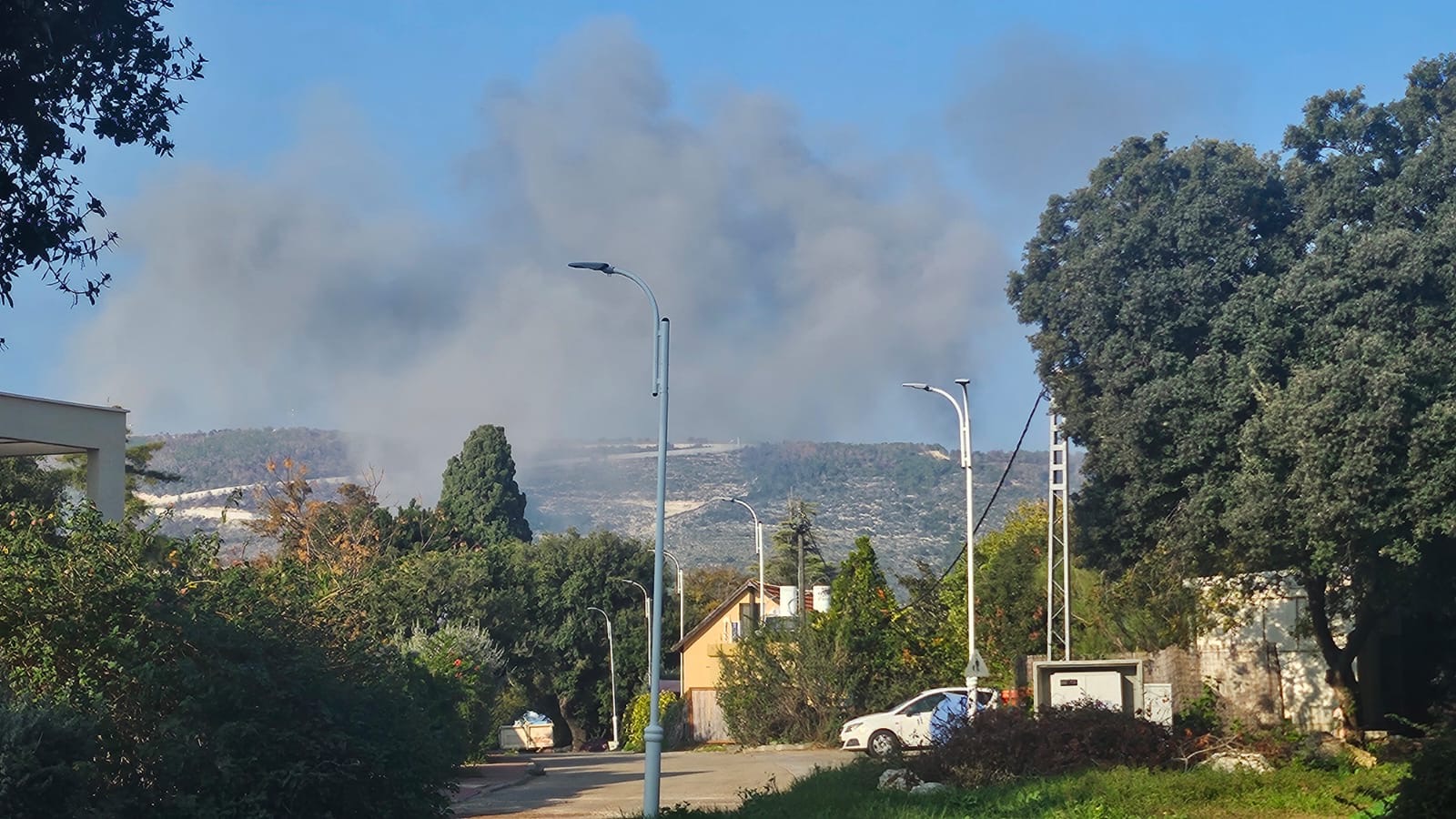
This photo shows a recent attack by Hezbollah forces on Kibbutz Metsuva. Beyond the smoke is the northern border and Lebanon. [Shay Zalel]
Gefen, one of more than 120,000 residents who have been evacuated from communities near the border in northern Israel, is now staying in a hotel in Tiberias with her two children (a third is doing a year of Sherut Leumi [National Service]), while her husband, Ran, a reservist, remains on the kibbutz, where he serves as part of the emergency standby squad.
Uprooted, having to live in one room in a hotel, driving long hours to her job – those factors are difficult enough. But to Gefen, living in the unknown is the most challenging.
“I don’t know how we can ever go back to the kibbutz,” she said, which is not much more than 2 kilometers from the northern border. “We don’t feel safe there. How will we ever have a sense of security?”
While not all northern Israel towns and settlements have been evacuated, residents across the region feel unsettled and uneasy as they struggle to accept what’s become the new normal.
Life after October 7 for the evacuated
Since October 8, Hezbollah-led forces have launched hundreds of rockets, drones and anti-tank missiles into northern Israel, in support of Hamas amid the war in Gaza. In the past week, there has been a dramatic uptick in fighting between Israel and Hezbollah since Israeli airstrikes killed several top Hezbollah and Hamas leaders. Residents have no idea when – or if – they can ever return to their homes, some of which have been destroyed in Hezbollah attacks.
Gefen said that residents of five kibbutzim from the Mateh Asher Regional Council, where a total of eight settlements have been evacuated, are now lodged at the same Tiberias hotel. They’ve set up a gan and a nursery school and have banded together to hold activities for children.Advertisement
“It’s a real community; we’re all here together. But it isn’t home,” said Gefen, 47, who was born on Kibbutz Matzuva and has lived there her whole life.
“It breaks my heart when I see how the kibbutz now looks so abandoned,” she said. “And I don’t see how the situation is going to change.”
Her older daughter rides a bus for more than an hour each way to study with her former schoolmates, but they are no longer in their usual school, which is too close to the border. Even students who have not been evacuated feel a sense of upheaval.
“A lot of students have lost their direction,” said Rami Glaser of Shavei Zion, whose son, Alon, is in eighth grade. Middle-school students from the moshav have been transferred to a different school where they can study only in the afternoons; elementary students use the school in the morning.
“For kids who find it difficult to study, now it’s really difficult for them to stay motivated,” Glaser said. Some teachers are in the reserves, and there is nobody to replace them; others have been evacuated, so they can’t come teach; still others leave school early when their child or spouse gets a sudden leave from fighting in Gaza.
Glaser said that parents try to protect their children but they still know “something serious is going on.” The entrance to the beachfront moshav is now lined with sandbags, concrete barriers, and guards. And the beach is closed indefinitely. Glaser and his wife, Esti, take their two children on day trips to get them away from the region, “trying to show them normal life.”
“But I see that so many kids have lost their self-confidence in every aspect of their lives,” Glaser said.Ordinary routines are no longer taken for granted.
Saeed Saeed, who manages the avocado groves in Rosh Hanikra on the northern border, said that he and his staff try to go to work each morning as usual, “but then the army tells us to stop because it’s too dangerous.” In December, Saeed said, he worked only five days the entire month.
“We can’t care for the trees, so they aren’t healthy,” Saeed said, a fact that will damage next year’s crop. He can’t harvest the avocados, either, and they’re left hanging on the trees. But most worrisome to Saeed is how he’ll protect his family members, who live in Sheikh Dannun.
“Every explosion is frightening,” Saeed said. “My granddaughter is so scared, even though her father – my son-in-law – is a reserve soldier.
“Hezbollah rockets don’t make a distinction between Arabs and Jews,” he said, pointing out that in the 2006 Second Lebanon War, 13 Arab civilians were killed by Hezbollah Katyusha rockets.
So far, Hezbollah forces have killed nine soldiers and four civilians.
Saeed also said there are only two regulation bomb shelters in his village; one at the school and the other in the senior citizens’ center. Most of the houses in the village were built in the 1990s, before the new type of bomb shelters were required.
“No one is safe,” Saeed said.
Despite the mandatory evacuation of Metulla, and even when the town was declared a military zone, Helen Bar-Lev, an 82-year-old artist and poet, didn’t want to leave. Bar-Lev, who has lived there for the past 16 years, wanted to stay in her own house, with her cats.
“More or less everybody had left before me,” Bar-Lev said.
Head of the Metulla Local Council David Azulai picked her up from her house on October 17, after the mandatory evacuation was already in place, and drove her out of the town’s gate.
“I didn’t want to go, because I didn’t think that any place in Israel was safe,” Bar-Lev said. At first, she, too, stayed in a hotel in Tiberias, but since then she has found an apartment to rent in Karmiel.
“It’s very traumatic to move at this age,” Bar-Lev said. With the aid of a social worker, she has finally sorted out “a lot of the bureaucracy.” Still, she isn’t sure her house will still be standing after the war, or if she’ll be able to sell it, or if she’ll feel safe enough to move back to Metulla.
Hezbollah “fires on houses in Metulla deliberately,” Azulai said. Some 140 houses have been partially damaged, and about 10 houses have been destroyed.
“In the south, the IDF is fighting,” Azulai said. “But in the north, the IDF hasn’t gone 1 centimeter into Lebanon.”Since early December, the IDF has started destroying much of Hezbollah’s forces and assets within firing range of the northern border. But, Azulai said, “Hezbollah keeps attacking, and we’re on the defensive.
“We don’t want a war,” he said. “We want the United Nations Resolution 1701 – signed by Hezbollah in 2006, which stated that the terrorist group must stay north of the Litani River – to be implemented.”
“Right now, citizens can’t come back here,” Azulai said. “It hurts. It’s very painful.”
He has stayed in Metulla since the war began with the emergency standby squad and a few citizens who haven’t left. But, he wonders, with Hezbollah forces so close, residents might never feel safe there again.
“I loved living in Metulla,” said Ari Singer, who was evacuated from Metulla with his girlfriend, Shoham Shlomi, a student at Tel Hai College. “But since October 7, I think about what could have happened if Hezbollah fighters had infiltrated the border or come in through tunnels, like Hamas did in the South. It would have been even worse here because there’s only one road into town, and it would have been completely closed off.”
Even before October 7, Hezbollah terrorists would shine laser lights at people in Metulla at night, Singer said. “Whether it was a sniper, someone trying to blind you while you’re driving, or just trying to intimidate you, it was very distressing.”
He would love to move back to Metulla “because it’s the most beautiful place in Israel,” but only if Hezbollah is pushed north of the Litani.
AT THE outbreak of the war, Galilee Medical Center General Director Prof. Masad Barhoum instructed the hospital’s medical teams to move critical departments, followed by other in-patient wards, to the protected underground complex.
In addition, the medical center outfitted a second trauma room in the emergency department to treat trauma patients wounded on the northern front.
“We are maintaining a very high level of preparedness in order to respond appropriately to a significant escalation on the northern border,” said Dr. Tsvi Sheleg, deputy director.
There’s traffic, shoppers, and people sitting in cafés along the main boulevard in Nahariya. But Shoshana Varga, a lifetime resident, said “everyone is tense and alert.”
“The war has started, even though it hasn’t started officially,” said Varga.
She works as a caretaker in the home of Bina Markowitz, 91, who has difficulty walking. When sirens went off at the start of the war, she and Markowitz had to take shelter in the stairway of the apartment building since they didn’t have enough time to reach the ground-floor bomb shelter.
“We left Nahariya in 2006 because we didn’t want to be in a bomb shelter 24 hours a day,” Varga said. “And that was only one month. This war is going to be worse.”
According to a Nahariya City Hall spokesman, the municipal administration holds meetings early each morning in conjunction with the army and security forces, and then administrators decide on the schedule for the city’s schools.
Shops and businesses remain open, the spokesman said, but they close earlier than usual.“The streets are empty in the evening,” Varga said.
Yet after work is the only time that landscape designer Fikri Yihie can go to the gym at the country club in Kibbutz Evron, near his village of Mazra’a.
“I work out so I don’t think too much about the war, the hostages, and all the people who were killed,” Yihie said. He doesn’t let his eight-year-old son watch the news on television for that reason.
“I don’t want him to see all this,” he said. “I want him to just be a child and play with his friends.”
[This is the end of my article. But not the end of my hope. Two of the people I interviewed here are Muslms who live here. We have a diverse, wonderful community and we are standing together in the face of enemies who want to destroy us.]
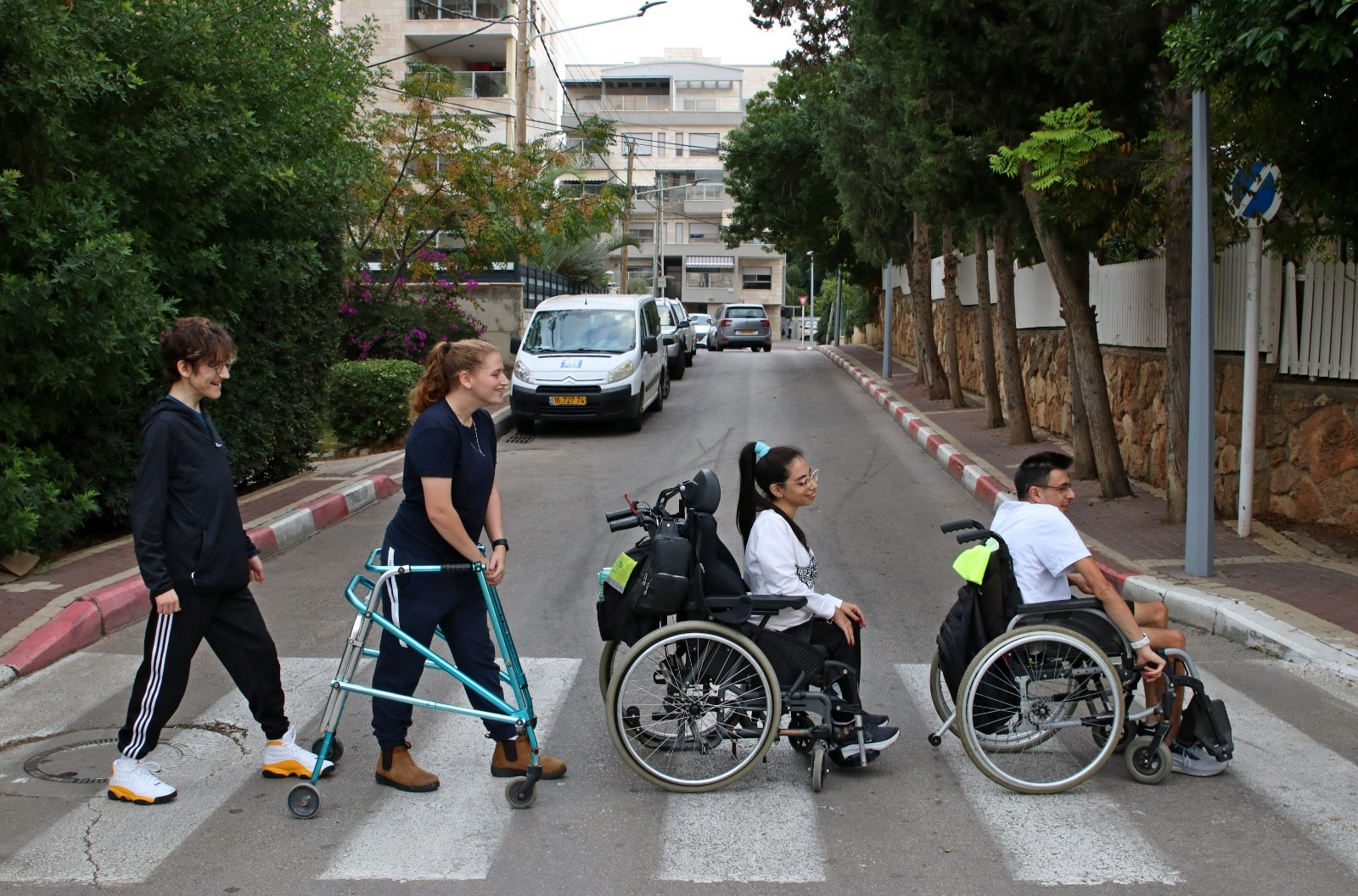
Here’s a tiny shimmer of hope in a very dark time during the Israel-Hamas War. At this group home for young people with special needs, a Muslim young woman and a Jewish young man share a special friendship. From my article in Times of Israel, which you can read here. By the way, Times of Israel, published in Israel, has up-to-date news you won’t see in most other media sites.
When the Israel-Hamas War broke out on October 7, Aya Jaber was afraid. As a Muslim Arab living in a group home in the northern Israeli city of Nahariya with her Jewish friend, Elad Kornhauser she wondered if she’d be seen differently or suddenly mistrusted.
After all, Jaber knew that workers from Gaza had taken photographs inside Israel and sent them to Hamas before the October 7 massacre, providing information that helped the thousands of terrorists who invaded Israel and brutally killed over 1,200 people, mostly civilians.
“I understood the fear,” 22-year-old Jaber said on a recent afternoon in their apartment, which is run by Kivunim, an organization that helps young adults with disabilities. “The Hamas attack made Jews look at Arabs differently.”
Kornhauser, 24, listened as Jaber spoke in the bright, cozy living room that they share with two other roommates — one Muslim, one Jewish.
“I am here with you, Aya, as always,” Kornhauser told her. “We’ve lived together for more than a year. Two months can’t ruin it.”
Kornhauser and Jaber share a deep connection because they understand each other’s challenges and limitations. Kornhauser has Familial Dysautonomia, a rare genetic mutation also known as Riley-Day Syndrome. This causes malfunctions in the nervous system, including nerves that regulate involuntary functions, such as body temperature, blood pressure, breathing and salivating. The genetic mutation occurs in people with Ashkenazi Jewish or Eastern European Jewish heritage.
“It’s an antisemitic disease,” Kornhauser joked.
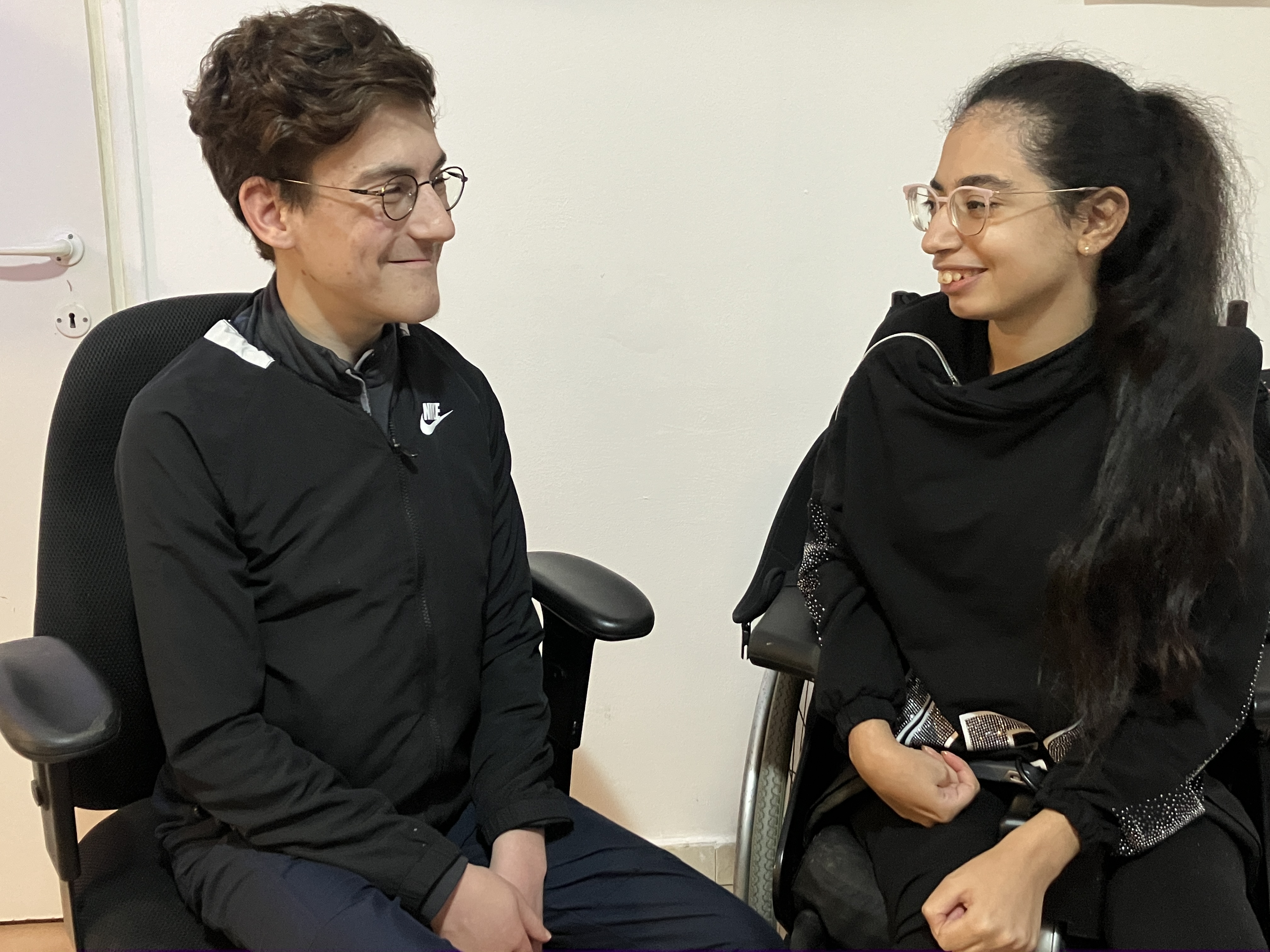
Elad Kornhauser, left, and Aya Jaber, flatmates and friends at Kivunim. (Credit: Diana Bletter)
Jaber has Cerebral Palsy which, she explained, is not a disease, but rather a group of disorders that cause neurological and musculoskeletal problems that affect posture, sensory perceptions, movement, and other functions. Able to move about in her wheelchair, Jaber serves in the Israeli National Service, volunteering in a senior citizens’ center in Nahariya. The program has been temporarily suspended, however, because there is not enough space in the protected rooms for all the residents and employees.
Hamas and Hezbollah ruined my plan,” Jaber said.
Instead, she participates in a vocational training center in Kibbutz Lochamei HaGettaot which is run in cooperation with Kochav Hatzafon, a non-profit organization for young people with disabilities. The participants learn employment skills, engage in social activities, and celebrate different religious holidays.
Jaber, from Haifa, is vivacious and talkative, with a quick sense of humor that equals the wit of Kornhauser, who’s from Ramat Gan. He calls her by her last name, Jaber, and she calls him Hauser. They like the same music, including the Beatles, Abba and Barbra Streisand. They enjoy teasing one another — as well as offering support. When they spoke about their experiences swimming, Kornhauser said he didn’t know how. Jaber responded, “I don’t know how to swim either. So?”
Then Jaber added that the few times she’s been in a pool, she didn’t like it when her family took photos of her in the water. “I look ugly,” she said.
Jaber and Kornhauser share the apartment with two other roommates, Maya Ronen and Maysoon Samaka. The four young people, all graduates of high schools for children with special needs, help with household chores such as cleaning, cooking (Jaber said they made gnocchi the previous night), and grocery shopping. They also receive care and assistance from a live-in staff.
Over the last 20 years, Kivunim has established 45 apartments in Nahariya and Haifa which now house approximately 120 participants. Of the organization’s 210 alumni, 76 percent are employed, 34% are married, and 82% are living independently. The organization helps individuals with physical disabilities, vision and hearing impairments, chronic illness and associated disorders, as well as high-functioning young adults with autism.
Because of the war, some of the participants have been evacuated to other apartments, and many activities, such as educational day trips, have been curtailed. A social worker, counselors and various staff members are available so that the young participants can share their wartime feelings and experiences.
Alon Cohen, 21, a Kivunim counselor, said he guides Jaber, Kornhauser and the others as they learn important life skills, such as how to navigate public transportation on their own, including using an app. The goal is to help them learn to live independently.
“If they want to learn to cook a certain dish,” Cohen said, “I help them with the recipe.”
The apartment is spacious and sunny, filled with artwork, books and board games. On a recent afternoon, while Kornhauser went to take a walk, Jaber participated in a dance session with other young women.
Jaber hopes to return to her original mission of performing her national service at the elder care facility in Nahariya.
“It depends upon Hezbollah and Hamas,” she said. She added that the October 7 massacre wasn’t only an attack on Jews.
“The terrorists killed a Muslim woman in a hijab,” she said. “It didn’t matter who it was. It was that they live here in Israel and it’s seen as a betrayal.”
Kornhauser is currently taking a course at the Open University on popular music in Israel. He isn’t sure what his future goals are, but Jaber said she wants to go into acting or communication.
“They’re both very smart and very capable of doing everything they want,” Cohen said. “I help them find the ways to get there.”
The war between Israel and Hamas and Hezbollah and the Houthis and Iran and Syria continues. Meanwhile, I wrote this piece for the Jewish Book Council’s Paper Brigade Daily. You can read it here where there are other writers on the war or continue here.
My library books are long overdue.
I took them out from a kibbutz library near where I live in the Western Galilee, a few weeks before the October 7 massacre. Most of the people on the kibbutz — four miles away from the border with Lebanon, where Hezbollah, Iran’s proxy terror army, has more than 150,000 missiles and rockets aimed in our direction — have left. And the library, with its surprising collection of English books, is closed until further notice.
That’s just one of the many ways my life in a beach village on the Mediterranean Shore has changed so abruptly, a place I’ve lived with my family since 1991.
I can’t sleep, I can’t eat, I can’t concentrate enough to read a book. And I’ve always loved reading! But what could I read, anyway, during the war? From my bookshelf, I picked up John Le Carre’s The Little Drummer Girl, and leafed through it, finding a few sentences about a character who mused about Israel, asking, “What are we to become… A Jewish homeland or an ugly little Spartan state?” I thought about how we returned to Israel after an exile that lasted nearly 2000 years. We revived the Hebrew language. We welcomed Jews from all over, from Afghanistan to Yemen. We became the start-up nation, fueled by a Do-It-Yourself ingenuity and creativity. We have a diverse population of almost ten million.
As a writer, I want my novels to reflect a perfected reality, and I want reality to be as redemptive as a novel. But living in the Middle East has crushed my romanticism. Israel still has to act like Sparta, even though since its founding in 1948, we’ve kept dreaming about how to beat our swords into plowshares.
So what have I read during the war? The only book I’ve been able to focus on is Daniel Jonah Goldhagen’s The Devil Never Dies: The Rise and Threat of Global Antisemitism. It confirms what I suspected: Israel does not cause antisemitism, but rather, antisemitism causes the demonization of Israel. I’ve come to understand that, before October 7, I lived in denial about the power of that hatred. Now, I can no longer pretend that there are those out there who don’t really mean it when they use the same words that Hitler used. Annihilate. Exterminate. Eliminate.
But it’s wartime and there’s little time for reflection. There’s too much work to be done. A few days ago, I started volunteering at a local school to teach English to junior high school students. They come in the afternoon; elementary school kids study there in the morning. The schools where the kids usually study have been closed because of the threat of Hezbollah attacks. There is also a lack of teachers: many of them have been called up for the Israeli Army’s reserve units while others have moved farther south.
The English teacher, Marina, explained to me that the students do not yet have books or study materials; they’re all stored in the school that is now part of a closed military zone. So Marina set up her computer to project vocabulary words on the board in the front of the classroom. I didn’t bring a computer; instead, I took a photo of the words with my phone and then sat with a group of eighth-grade students in the bomb shelter.
The kids were rowdy, unruly, boisterous. Still, I worried about the words they had to learn for a story: crime, scene, blood, evidence.
I asked the students to write sentences using the words, hoping they wouldn’t write about Hamas or the war. They didn’t. They wrote about criminals, robbers, and detectives.
They laughed. They sang “Head, Shoulders, Knees and Toes.” They joked. Some of the kids didn’t have pencils. One asked to go to the bathroom because he didn’t want to read his sentences out loud. I’ve given private English lessons but I’ve never taught in an Israeli school before. I improvised the way a neighbor who owns a second-hand clothing store now guards the entrance of our village, or the way high-powered tech executives are now picking lemons and cherry tomatoes in southern Israel because of the shortage of farm workers.
After school was over, I walked outside and suddenly there was an explosion. The boom sounded close.
“If it is outgoing, you don’t have to worry about it,” my husband always tells me.
Outgoing means Israel is shelling Lebanon. Incoming means a rocket or missile from Hezbollah.
I rode back to my village on the shore of the Mediterranean on my 250-cc scooter, the one I usually ride to the library, and tried to act as if I’m a character in a novel who doesn’t give in to fear.
I thought about the books I want to take out and read once the war is over. I thought about the books I want to write. I thought about the history of the People of the Book and the present moment. Something enormous is happening right now, and I am part of it. I am writing the story of my life. I am writing the story with my life.
I took the photo on the beach in nearby Nahariya early one morning. It’s amazing to find beauty in the midst of war.
This article originally appeared in The Times of Israel here.
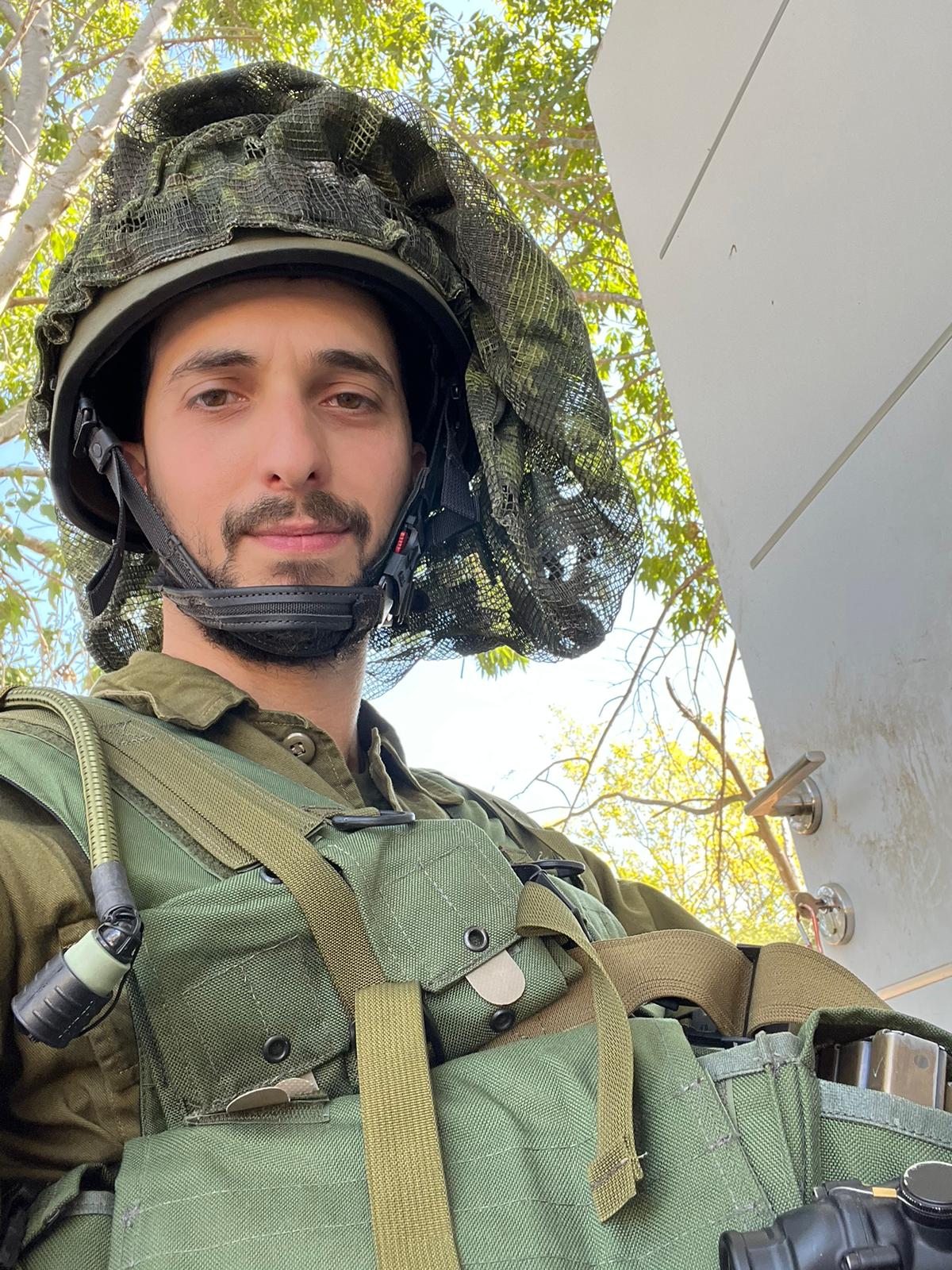
Snir Dayan has fought for Israel on the streets of New York City and on social media. And now, the 29-year-old has left behind his successful New York business to return to Israel to fight once again in the Israeli Army.
Dayan was watching the news at midnight on October 7 and saw that there had been a Hamas invasion from Gaza. At first, he didn’t think much of it. He had seen attempted incursions when he served in the Israel Defense Forces’ Golani Infantry Brigade on the Gaza border in 2014. He said he was calm at first, and went to sleep, but a few hours later, his phone “exploded” with messages from friends in New York and Israel.
He learned the extent of the Hamas terrorists’ atrocity: 1,200 men, women and children slaughtered, thousands wounded, and 240 taken into captivity in Gaza. Dayan, who has a company that provides personal security as well as a shop selling security equipment in the Chelsea district of Manhattan, was soon giving a speech to raise funds for Israel at an event in Hudson Yards Mall.
“I helped raise $70,000, but I stood there in the middle of this cocktail party and I just didn’t feel right,” Dayan said. Feeling powerless and helpless, he knew he “just had to go back to Israel.”
Dayan called someone in charge of the Israeli Army reserves who informed him that when the army sent out 150,000 emergency induction notices for soldiers a few days after the October 7 attack, 300,000 responded. Since then, the army has mobilized approximately 360,000 reserve soldiers. From New York, Dayan called a good friend who arranged a phone call with Dayan’s former Golani unit. The commander asked a few questions and then said, “Welcome to the reserves, and get here as fast as you can.”
Like thousands of other Israelis who were traveling or working abroad, Dayan returned to fight. He landed in Israel on October 20, and was already in his uniform on the northern border with Lebanon on October 21, fighting against Hezbollah, Iran’s proxy terror army.
“The IDF lost eight soldiers and a lot of soldiers were injured on the northern border, most of them from anti-tank missiles that Hezbollah was shooting,” Dayan explained. “Another thing that we dealt with was explosive drones and attempts of terrorist infiltrations.” Dayan, who had taken up his former position as a sharpshooter, said that despite all the dangers, he had a “big smile” on his face.
“Fellow soldiers told me, ‘you look too happy for someone in a war zone,’ but the helplessness I had felt in New York left me,” Dayan said. As strange as it seemed, Dayan, who is also a krav maga instructor, felt satisfied being in Israel where “I could help take part in defending my country. This is my natural place. This is where I belong.”
Dayan, now stationed with a Golani unit on the coastline in Northern Israel, said that when he’s not fighting on the battlefield, he’s fighting against antisemitic propaganda on social media. He gives people short explanations about Israeli history that are easy to understand. For example, when people accuse Israel of committing genocide against the Palestinians, he tells them to look at the numbers.
“There were 200,000 people in Gaza 75 years ago,” he said. “Today there are 2.8 million.”
Or, when people tell him that Jews never lived in Israel before 1948, he counters, “What about Jesus? He is known as Jesus of Nazareth, which is right here in Israel.”
He also has to explain to well-meaning Western liberals that the concept of compassion “just doesn’t exist in the Middle East.”
“In Western society, you think that if you show compassion to someone, they’ll have compassion for you. But compassion is not a currency in the Middle Eastern market. Here, when you show compassion, terrorists feel it will be easier to eliminate you. The only important currency in the Middle East is strength.”
Part of Dayan’s family is from Morocco; one of his grandfathers can trace his roots in Haifa back seven generations. Dayan has lived in New York City since 2015 and has always been active in self-defense for New York Jews. In In 2021, during an anti-Israel protest in front of a Jewish restaurant, Ess a Bagel, he and a friend went out with Israeli flags and were attacked by the demonstrators.
“It could have ended up in a lynching,” Dayan said. But in a strange twist, Dayan was arrested by a New York City policeman even though he was defending himself.
New York today is even more hostile to Israel, he said, and “it’s the same around the world.” At a recent demonstration in Australia, people were shouting “Gas the Jews.” To Dayan, “it’s clearer than ever that Israel is a miracle that must exist for the safety and prosperity of the Jewish people.” But, he says, “We need to keep explaining why we have the right to exist.”
“We live in the Middle East and we’re the only functioning democracy so we have to be the strongest military in the region,” he said. “If not, we won’t survive.”
He said he feels that Israel—and Jews—will have to keep fighting “forever.” But all that doesn’t deter him.
“I’m lucky,” he said. “I was born into a nation of warriors.”
Dayan, center, holding the Israeli flag, with his friend, Amit Skornik, at a May 21 Anti-Israel protest in New York. (PHOTO CREDIT: COURTESY)
If you haven’t a clue about where to read in-depth news on Israel, check out Times of Israel, The Jerusalem Post and Ynetnews for coverage.
In the early morning on my bike ride delivering coffee to Israeli soldiers, I ran into Daniel Shkolnik. He’ll be 80 in a few months. My husband and I met him in the early 2000s when he worked at Café Carter in the nearby town of Nahariya. He used to grind our coffee.
In August, 2006, Hezbollah—Iran’s proxy terror army—fired Katyusha rockets into Nahariya. The rockets hit the store, with Danny inside. He lost almost all his hearing. He suffered burns on his left hand. He lost his left leg.
He is one of the most cheeful people I’ve ever met. Almost every morning, he walks to the Nahariya Sports Center and works out in the gym. When I saw him two weeks ago, I was pouring coffee for some young soldiers who were on guard duty. (There is a possibility that Hezbollah terrorists might attack from the sea.) The soldiers heard Danny’s story. They looked at him in wonder that he was still out and about. Still smiling. Then Danny joked, “Well, lightning doesn’t strike the same place twice so here I am.”
After he walked away, one of the soldiers said, “Oh, I wanted a photo of him.”
They were up all night guarding and they thought he was brave. He is. He has not stopped living.
This morning, when I saw him, Danny said, “Hezbollah rockets is waiting for us.”
We both looked over our shoulders at Lebanon, about six miles away. Just over the crest of the hill, on the other side of the border, are 150,000 rockets and missiles aimed in our direction.
“My father was born in Israel,” Danny said. “My grandfather was born in Israel. My grandfather’s grandfather was born in Israel. We go back to the 1800s. And we’ve known nothing but war.”
So here we are, unsure when Hezbollah will strike. Its leader, Hassan Nasrallah, has called Israel a microbe that must be destroyed.
And it is the mission of its benefactor, Iran, to erase Israel off the map.
People have threatened to destroy the Jews throughout history. The Egyptians enslaved us. The Italians put us in ghettos. The Crusaders killed us. During the Shoah, they wiped out most of the Jews in Europe. Nazi Germany murdered 80-percent of the Jewish population in Greece alone. On October 7, 2023, Hamas murdered 1,400 men, women and children, wounded thousands, and kidnapped 240 people still being held captive.
But we’re still here. There’s a reason. And our history is proof that we will survive Islamic threats. And Hamas and Hezbollah will be just one more in a long line of barbarians who sought to destroy the Jews. But the barbarians will be relegated to the dark rubble of history while we, the Jews, no matter how much we’re hated, we will continue to be a light unto the nations.
If you want to learn more about what life is like now in northern Israel, you can listen to the Life’s Accessories podcast, where I talk about the situation. Tune in here.
And some of you have asked what you can do to help. Here are a few things:
Put up posters of the KIDNAPPED men, women, children and babies being held captive by Hamas in Gaza. They range in age from 10 months to 85. You can download the photos and put them up on billboards, poles or public stations. Act quickly and don’t provoke officials or anyone else. This is the site that you can get more information here.
Write to your representatives! Tell them you support Israel’s military campaign to dismantle Hamas, a terror organization that aims to “eliminate, annihilate and murder” Israelis.
When people call for a “ceasefire,” you can agree. A ceasefire ONLY after Hamas frees ALL the hostages.
Remember that America, Britain, France and their allies went to war to stop Hitler and Nazi Germany. Israel has every right, and a duty, to defend her citizens.
Find out where organizations that you support (in the arts, in the LBGTQ+ community) stand on the issue of Israel vs. Hamas.
If you graduated from a university or college, you have a voice as part of the alumni. Find out if the university provides a safe space for Jews on campus.
Write to newspapers, magazines or TV stations if you see that they are presenting anti-Israel news.
Remember that the United Nations is controlled by Russia, China, Iran, Arab countries and other states that are antisemites and anti-Zionists. Since 1948, the UN has never insisted that Arab countries absorb the Palestinian refugees, not even Jordan, which is 75% Palestinian. Do not give any money to UNICEF. Do not believe any “facts” coming from any UN agencies, including the World Health Organization, because they are controlled by Hamas.
Here’s an update on Hamas’ war against Israel and a spark of light in the middle of all this darkness! If you want to read the article on the Times of Israel website, look here. The Times of Israel is one of the best sources of news.
Every morning at dawn, I ride my bicycle to deliver coffee and tea to the soldiers stationed along the beach near where I live in Israel’s Western Galilee. I’ve taken it it upon myself to do this ever since troops were deployed here, a few days after the Hamas massacre on October 7. That was in southern Israel. Here in the north, we’re preparing for an attack by Hezbollah, Iran’s proxy army on the other side of the Lebanese border, about eight miles away.
I ride along the beach, looking out at the sea. Navy boats patrol on the turquoise-blue water. There are streaks of orange in the sky, loopy trails left by Israeli fighter jets. The sunrise seems more beautiful than ever.
When I reach the first group of soldiers, they say that they were dreaming about a cup of coffee right before I appeared. They’re always happy to see me. This time, I was even happier to see them because I wanted to share the news.
Our son just had a baby boy a few hours ago. My first grandchild!
Mazel tov, Grandma!
I didn’t know any of the soldiers before—but they now feel like family. Pulled away from their ordinary lives, they’re in olive-green fatigues, arriving from around the country. There’s an engineer, a pediatrician, and a graphic design student who sent me photographs of his artwork.
As our oldest daughter said—my husband and I have a blended family of six children—in other countries, there are six degrees of separation. In Israel, there is zero degree of separation.
We all know someone who’s been devastated by the October 7 attack. A young friend, a tattoo artist, lost four of her friends at the Nova Music Festival, people in their early twenties. Another of our sons has a friend, Alon Gat, from Kibbutz Be’eri. When the attackers invaded, he and his wife, Yarden, fled. Yarden passed him their little girl and ran in one direction. Alon, barefoot and carrying their daughter, ran in another. Yarden was captured. She and Alon’s sister, Carmel, are now among the 200-plus captives being held in Gaza. Alon’s mother, Kineret, was murdered during the kibbutz attack.
Nobody can sleep well anymore—or sleep at all. Our eldest son, in Tel Aviv, is mostly deaf and has to sleep with his hearing aid so he can hear the sirens go off whenever missiles are fired at the city. He doesn’t have a bomb shelter and when there’s an attack, he goes into the stairwell and waits with an elderly neighbor until it’s quiet again.
If Israel is a start-up nation, then this feels like a do-it-yourself war. In our beach village, people have volunteered, joining WhatsApp groups to offer help with babysitting, the elderly, the soldiers’ laundry, medical services. There’s a 17-year-old girl who rides around on her bicycle, delivering supplies to and from the War Room, in what was once an abandoned bomb shelter.
My husband, 71, still drives a tractor in the avocado groves of our village. He and the crew of local Arabs and Jews have known one another for years. They’re working together until rocket fire begins. When a train runs past, it sometimes tricks me into thinking that our routines haven’t changed. But everything has been upended. There are more than 60,000 internal refugees from both southern and northern Israel who’ve been displaced.
Our younger son and his girlfriend were evacuated from Metullah, the northernmost point in Israel. It’s a charming town, known as the Tuscany of Israel, now a closed military zone. They stuffed clothes into their backpacks, took their dog, and drove south, not knowing if their house will still be standing when they return. Not knowing if they’ll ever feel safe enough to live so close to the Lebanese border where from their street they could see Hezbollah flags. And where Hezbollah has stockpiled about 150,000 rockets and missiles since the Israel-Hezbollah War in 2006, under the watch of UNIFIL, the United Nations International Forces in Lebanon, who call themselves, without any sense of irony, peacekeepers.
Meanwhile, on my bike ride to deliver coffee, I talked to a soldier who said he proposed marriage to his girlfriend when he went home for a 24-hour leave a few days earlier.
“Did she accept?”
“Yes!”
“Of course she accepted,” joked another soldier. “He had the gun.”
Sometimes we try to joke and make each other laugh. Sometimes we’re too sunk in despair.
Our son, Shlomie, the new father, was a medic in a paratroopers unit during the Israel-Hezbollah War in 2006. He was with Michael Levin, a soldier from America who volunteered in the Israeli Army. During a battle in a Hezbollah-controlled village in Southern Lebanon, Michael was killed and Shlomie was wounded. Ever since that last war, Shlomie has struggled with PTSD, and now, in the middle of this war, his fiancee, Maya, has given birth to a baby boy.
It’s what I’d call a tikkun, a repair, a healing.
The couple didn’t have a chance to get married because the war broke out. Now, the rabbi said he can do a combinah, a combination of a wedding followed by the brit on the same day.
Islamic terrorists aim to destroy the Jewish people and break our spirits. But we’re still here. Still alive. And that is enough of a reason to celebrate.
The Hezbollah terror army, backed by Iran, now has more than 150,000 rockets and missiles aimed in Israel’s direction. All brought to Southern Lebanon under the watch of UNIFIL, the United Nations Interim Forces in Lebanon. And they call themselves “peacekeepers.”
Meanwhile, as we wait for a war to break out at any moment, here’s my article on what it’s like to live in Israel’s Western Galilee on the brink of war. This is from Times of Israel, an informative, up-to-the-minute news site. You can look at the article here
My favorite beach is now a military zone.
In the summer, it’s crowded with sunbathers and beach volleyball players and now it’s empty except for the soldiers.
Last week, I started bringing them coffee (instant Nescafe with milk is a treat, one of them said), or Turkish coffee with cardamom each morning. I gave them clementines I just picked from our tree. Yesterday, I took home their laundry to wash in our machine.
I always ask them their names, so I’ll remember.
Just in case.
Dotan, Guy, Ofir, Ben.
In their regular lives, they are musicians, chefs, engineering students, law interns. One has four kids. One has long dreadlocks. Another has a nose ring.
They were called up to their reserve units and they came. One landed in Israel on Friday and was with his army unit the next day.
Whenever I give them something, they always thank me. I say, “No, no, thank you.”
How can you thank people for putting their lives on the line to protect you and defend your country?
People ask me, “Are any of your kids in the army now?”
None of my husband’s and my six children were called up this time, but it doesn’t matter. All these soldiers feel like my kids.
Sometimes I know their families, or we know the same people. I was walking with my son’s girlfriend, Shoham, and we started talking to a soldier, Jonathan. It turned out that Shoham’s mother was Jonathan’s teacher in high school.
It’s such a small country. We all know someone. We all knew someone. Someone who was murdered. Abducted. Widowed.
One of our sons who was wounded in the 2006 Israel-Hezbollah War said, “Israel is a PTSDC.” A Post-Traumatic Stress Disorder Country.
Here in the Western Galilee, we’re holding our breath, waiting for Hezbollah to attack from Southern Lebanon, on the other side of the northern border. Maybe Hezbollah terrorists will come in from the sea. Maybe they’ll come in on trucks and motorcycles, like Hamas terrorists did in the south on October 7. But this time, we know what to expect, when the death squads come. This time, we’re prepared.
Everything seems surreal. Our 83-year-old neighbor, a classical musician and organ builder, plays haunting tunes on his piano that are occasionally drowned out by the sounds of helicopters and drones and the shouts of soldiers. Before dawn, I can hear the voice of the muezzin calling from the mosque across the road. Then there are the sounds of jackals.
Yesterday, I rode on my scooter to do some errands. At a grocery store in the nearby town of Nahariya, a middle-aged Jewish woman was talking to the Muslim woman in a hijab working behind the meat counter. They seemed to know each other. They were smiling at each other. Smiling. It astonished me. Their dialogue felt like a relic from a time before October 7 when Jews, Muslims, Christians and Druze lived peacefully here in the Western Galilee. It all seems so fragile now, so precarious.
In May 2004, I got a reply to a letter I wrote to former Israeli President Shimon Peres:
Dear Ms. Bletter,
I want to thank you for your touching letter of May 9 and for not losing faith in the pro-peace efforts underway.
I would like to reassure you that building a better future for all our children serves to inspire our sense of motivation, and I trust and pray for the day when we can live in peaceful coexistence with our neighbors.
With all good wishes,
Shimon Peres
Now, 19 years later, my husband and I sort and fold the soldiers’ laundry. When I return it in neat piles, I talk some more with the soldiers. I think about Israel, my adopted country, a country that keeps having to fight, over and over, for our right to exist, for our right to contribute to the world our sense of light and justice and creativity and tolerance and vibrancy.
I took this photograph on Thursday, October 19, in our local supermarket in the Arab village across the road. This is what Hamas terrorists and their supporters do not want to see: an Arab woman and a Jewish man working together. The woman has a hejab; the man has a kippah. This is our reality in the Western Galilee, Israel. Jews, Muslims, Christians and Druze living together. This is Israel.
And it’s only because Israel is what it is—a liberal democracy founded on democratic principles—that people hate us. We are the only democratic, Jewish enclave in the world. We exist. We function. We are the start-up nation. We are the comeback kings. We revitalized our ancient language, Hebrew, and it is spoken by more than nine million people. We are creative, think-outside-the-box inventors who’ve given the world cell phones, drip irrigation and WAZE, among countless other inventions.
This isn’t a war against Israel and the Palestinians. If protestors cared for their Arab brothers, they would be out in force against the Syrian regime that killed 500,000 Arabs, where there are now 15 million Muslims in dire need of humanitarian aid.
This is a war against the Jews. This is a war against Israel. This is not a conflict. Islamic imperialism is is a threat as terrible as the Holocaust.
Zion is one of the many names of Jerusalem. Jerusalem became the capitol of the Jewish state 3000 years ago, during King David’s time, and remained its capitol for more than 1000 years.
Jews are indigenous to this land. Being anti-Zionist means denying the right of Jews to their homeland. If you somebody supports the right of other indigenous people to their land but denies such a right to Jews, that person is an anti-Semite.
If someone tells you they want to “free Palestine,” that person is an anti-Semite. Because that means they want to destroy the Jews here. It means they support the destruction of the Jews. It’s what has happened in every Arab nation. Islamic terrorists slaughtered so many of our people but we will not let it happen again.
1. Who you are is life’s gift to you. What you make of yourself is your gift back to life.
2. To be more you, be less you. Do the opposite of what you're used to doing.
3. Your personal record is against yourself and nobody else.
4. Fear is Forgetting Everything’s All Right
5. Put gratitude in your attitude.
6. Live in day-tight compartments.
7. When agitated, pause and breathe deep.
8. Remember the problem in front of you is never as large as the power behind you.
9. Take care of your mind, heart, body and soul each day.
10. You only get to live once and if you do it right, that’s enough.
Diana Bletter is the author of several books including The Invisible Thread: A Portrait of Jewish American Women (with photographs by Lori Grinker), shortlisted for a National Jewish Book Award, a novel, A Remarkable Kindness, (HarperCollins), a memoir, The Mom Who Took of on her Motorcycle, and The Loving Yourself Book for Women: A Practical Guide to Boost Self-Esteem, Heal Your Inner Child, and Celebrate the Woman You Are, an Amazon top-seller in several categories, and The Loving Yourself Workbook for Girls.
She is the First Prize Winner of Moment Magazine's 2019 Fiction Contest. Her work has appeared in The New York Times, The Wall Street Journal, Commentary, tabletmag, Glamour, The Forward, The North American Review and is currently a reporter for The Times of Israel.
Diana and her husband have six children and an unofficially-adopted daughter from Ethiopia. They live in a small village on the Mediterranean Sea in northern Israel.






 DIANA BLETTER