
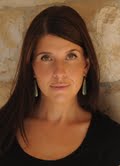
Molly Antopol, Author, The UnAmericans
I’m honored to host writer and writing teacher Molly Antopol, whose wonderful collection of short stories, The UnAmericans, will be published in February 2014 by W.W. Norton. You might not have heard of her. Yet. But you will.
Diana: Welcome, Molly! Your stories take us on a whirlwind ride around the world, from California to Kiev to Israel. And not only through space — also through time. “Duck and Cover” is set in the age of Eisenhower; “My Grandmother Tells Me This Story” is set, sort of, in World War Two. Can you tell us a bit about what got you writing?
Molly Antopol: Many of the stories in this book were inspired by my family history, notably their involvement in the Communist Party. I come from a big family of storytellers, and I grew up surrounded by tales of surveillance, tapped lines and dinnertime visits from the FBI. Those things—combined with my very nerdy love of research—informed my McCarthy-era stories.
In terms of the Israel stories, I’ve spent my entire adult life going back and forth between there and the U.S. I lived there for years—I used to work for a peace group, and at a youth village aiding Russian and Ethiopian immigrants. And for the past seven years, since being on Stanford’s academic schedule, I’ve spent my summers there.
Eastern Europe is a part of the world that’s always fascinated me. My family’s originally from there, many of my favorite books were written in (and about) communist-era Europe, and in recent years I’ve been lucky enough to have received writing and research grants to a number of countries in the region. It’s interesting—though my family loves to tell stories, the one place I never got to hear about was Antopol, the Belarusian village where my relatives came from, which was virtually destroyed during World War II. A little more that a decade ago I was living in Israel and wound up at a holiday party in Haifa, where I met an elderly woman from Antopol who had known my family. It was one of the most extraordinary moments of my life. She led me to an oral history book of the village, written in Hebrew, Yiddish and English, that her son had put together. The moment I finished reading it (I remember just where I was, at the kitchen table in my apartment in Tel Aviv), I began writing The UnAmericans.
Diana: I love the way you’ve entered the hearts and minds of characters in these far-flung places. You did that in “Minor Heroics” so well – I really felt as though I was reading an Israeli soldier’s secret journal entry. Edna O’Brien wrote, “Women are better at emotions and the havoc those emotions wreak.” Do you think this applies?
Molly Antopol: Thanks! I’m so glad you thought I achieved that in “Minor Heroics.” I’m a big fan of Edna O’Brien’s writing, but I’m not sure I agree 100% with that quote. Some of the writers I admire most for their emotional generosity and psychological precision are men—including James Baldwin, Sergei Dovlatov, David Grossman and Isaac Babel. That said, there is a certain special kinship I feel with so many female writers. At this point in my life, I’ve only experienced what it’s like to live in the world as someone’s daughter (rather than someone’s mother), and many of the writers I’ve felt closest to—Grace Paley, Alice Munro, Natalia Ginzburg, Edith Pearlman—write so intimately and humanely about motherhood. In a sense, I’ve turned to their stories in the way I might turn to a wise and generous relative for comfort and advice.
Diana: The sense of Jewishness pervades your stories, even if the stories are not specifically about Jewish themes. Can you tell us about that?
Molly: I grew up in a secular—but very culturally Jewish—family. There have been times in my life when I’ve faced something painful and have deeply wished I were religious, because maybe then I’d be able to make sense of the loss, and would have a safety net of people to fall back on. But (blame my communist family!) I just can’t get myself to believe.
When I was very young, it was just my mother and me. Maybe because of that, I’ve always had a lot of very close individual friendships but felt lost and crowded whenever I was part of a big, organized group—it’s as if one side of me craves community and the other bucks against it. This chasm grew even wider when I let writing become more central to my life. Of course I want to be there for my friends and family during their worst times and to celebrate with them during the best. But the truth is that when something hard is happening with me, as much comfort as I get from them, I find equal solace being alone in a room, finding ways to make sense of—and sometimes even control—the scariest parts of life through writing.
Diana: What is the novel you’re working on now?
Molly Antopol: It’s called The After Party. It’s set in Israel, Eastern Europe and New York right after the fall of communism. But I’m superstitious about discussing a book-in-progress—I shouldn’t say anything else!
Diana: Finally, www.thebestchapter.com explores how to write your best chapter and also how to live your best chapter each day in the story of your life. What are some things you manage to do to take care of yourself each day?
Molly: I go running—I find that I’m able to untangle so many problems in my stories on long runs. And I take my dog on lots of walks, which helps me in the same way. Though I probably look insane, wandering around my neighborhood in my pajamas in the middle of the day, talking to myself.
Thank you so much, Molly! For more information, visit Molly Antopol’s site here.


 DIANA BLETTER