Tool For Tuesday: Laugh At Yourself. But Really.

I often talk about how I’m learning to be more me by being less me. I’m trying to do things I wouldn’t normally do, stepping past the restricting idea I have of myself. See my post — I’m the kind of person who ___ — about how we need to try new things.

One thing I’ve noticed is that I take myself far too seriously when it comes to my mistakes. I’m hard on myself. I expect myself to be perfect. I’m the kind of person who ____demands perfection of myself.

This often leaves me disappointed in myself – and my ordinary humanness. I now know that if I want to start a new chapter in my life, I have to start a new chapter. Which leads me to my story. I was sitting down to dinner with several guests the other night. I’d made spaghetti with pesto sauce, salad with fresh oregano, feta cheese and sweet cherry tomatoes, and garlic bread. I looked around the table, feeling so happy, grateful and so (I admit it) pleased with myself. I felt just like Little Jack Horner, who said, “What a good boy am I!” I thought, Oh, what a good cook am I.

And just then…

“Mom! I found a hair in my spaghetti!” said my oldest son.

At first I turned bright red. My jaw dropped. I stammered, looking around at my guests who were looking at me, wondering how I’d respond.

“Oh, I’m so glad,” I said, recovering myself. “I was looking for that hair!”

Yep, we have to laugh at ourselves. When was the last time you laughed at you?

To be more you, try being less you.

Posted in Be Less You To Be More You, Relationships, Tool For Tuesday, Uncategorized | Tagged , , , , , , , , , , , | 2 Comments

The Love/Anger Acid Test

“I don’t know about you,” my friend Lily was saying, “But it’s so hard for me to feel love toward someone I’m angry with – and to be angry at someone I love.”

Lily had just slunk in for a cup of coffee after another tiff with her teenage daughter. She was struggling with the Love/Anger Acid Test. “If you can’t be with the one you love, honey, love the one you’re with,” goes the Crosby Stills Nash classic. But a tougher spin is: Love the one you’re mad at, honey.

“I’m willing to look at myself this time,” Lily said. “I’m willing to try to change the way I’m reacting.”

She admitted that she came to the argument with her old, worn back story: “my daughter is acting like a teenager. Again.” Savannah was mad and that made Lily mad, too.

We talked about Dr. Phil saying that past behavior predicts future behavior unless someone decides to change. And Lily wanted to change. She didn’t want another argument just like the one before, and the one before that. ESPECIALLY the day before Mother’s Day. This time, she thought of the words she paraphrased from the St. Francis prayer, asking for help to understand rather than to be understood. Lily prayed to understand her daughter who’s filled with roiling emotions.  I’ve been through this, too, she said. I know what it’s like. I’ve been there.

This idea helped her put a space between her knee-jerk reaction and her response. That tiniest of pauses – those deep breaths – helped her push aside her automatic anger. Lily was able to detach from her own feelings – and focus on understanding her daughter. She was able to reach out to her daughter with understanding . They talked and cried and worked things out. They’ll probably — no, definitely, have new tiffs down the road. But Lily said she able to open her heart enough to feel both the anger and the love.

What about you? Is it easy for you to express anger? And when you’re angry, is it easy for you to feel the love?

“Past behavior predicts future behavior unless someone decides to change.” Dr. Phil

Posted in Anger, Other people and us | Tagged , , , , , , , , , , , | 5 Comments

Jeffrey Moussaieff Masson: On Denial, Killer Whales, and the Human Condition

JEFFREY MOUSSAIEFF MASSON

I am honored to share my exclusive interview with Jeffrey Moussaieff Masson today.

Jeff is the best-selling author of dozens of books, including The Assault on Truth:  Freud’s Suppression of the Seduction Theory (Farrar Straus & Giroux, 1984); Against Therapy:  Emotional Tyranny and the Myth of Psychological Healing (Athenaeum, 1988), A Dark Science:  Women, Sexuality and Psychiatry in the 19th Century (Farrar, Straus & Giroux, 1987). He has translated and edited The Complete Letters of Sigmund Freud to Wilhelm Fliess 1887-1904, among dozens of other books, essays and even an introduction to one of my favorite children’s books, Kenneth Grahame’s The Wind in the Willows. His book, Dogs Never Lie About Love, has sold over 1 million copies worldwide.

His forthcoming book is Us and Them: Apex Predators and the Search for the Origins of Good and Evil.  Jeff says, “Here is the thesis in one sentence:  in the 20th century alone humans have killed more than 200,000,000 members of our own species; during that time orcas (killer whales) have killed exactly not a single other killer whale.  So what happened to us?”

Jeff’s writing on therapy, Freud, and society’s suspicious views about women speaking out about their experiences opened a door for me. His empathy granted me permission to trust my own voice. I came to understand that to live my best chapter, I had to ask myself, who’s living rent-free in your head? (See my post on that here.) Once I figured out that I was trusting the voices of other people – and ignoring my own perceptions – I started to think clearly. And see clearly.  Voila! I started to change. Jeff’s work has helped me begin my next chapter.

Here’s an abbreviated version of Masson’s work on the curious U-turn in Sigmund Freud’s thinking. Freud originally believed women’s stories about their disturbing sexual experiences. But his ideas were so revolutionary, so ahead of his time and so disturbing to his colleagues, that he retracted them. Freud did a complete flip-flop and began stating that women were merely talking about their sexual fantasies. This dogmatic reversal – quashing women’s own memories and insisting they were only fantasies – continues to cause society to question women’s perceptions and their memories, their grasp of “objective reality” and their ability to serve as authorities — or even witnesses — of their own experiences.

Masson’s books are still revolutionary because they help change how we think about ourselves and that is the first step toward living our best chapter.

Diana: My recent post on countering depression and the Dalai Lama got more hits than any other. I’m still struck by how people are looking for a way out of what they feel is depression. (I’m not talking about clinical depression but a general malaise.) You’ve written so much about people (especially women) looking for “cures,” especially from men. Do you think that is part of the human condition? Or is something else going on?

Jeff: As you know, I am not a great fan of ANY kind of therapy, especially psychiatric ones, for what is simply part of the human condition.  I don’t use the word depression.  I say sadness.  Now of course I understand that some sadness is much worse than others, some perhaps almost unbearable.  But the idea that you can pay somebody to make it go away seems to me wrong.  I often felt melancholic when I lived in Toronto, but rarely in Berkeley or Auckland.  Frankly, I think it has to do with sunshine.  I am a great believer in Vitamin D, and the sun.

Diana: You have been brave in saying things that many people just don’t want to hear. What has struck me is how you were studying in the most respected institutions of learning and yet it dawned on you that what you were learning didn’t ring true. In a way, it’s like stepping out of denial and seeing things clearly. Was there a sudden crisis that inspired you or a building up of ideas? And what do you recommend people can do to begin to be aware – and begin to change?

Jeff: Well, it is a kind of whistle-blowing of one’s own self.  You have to recognize how you have often been duped by the powers that be, often even the educational powers that be.  When I think of how much that is taught at Harvard is simply wrong, I am astonished.  But these are not things that can really be proven, only intuited.  There were of course some wonderful teachers there as well, but the entire institution, in a sense, was a denial-building machine.

For example, in the department of psychology, Richard J. McNally teaches the students that women think they were sexually abused when they were not.  He compares their “faulty” memories with those of people who claim to be abducted by aliens.

This is just wrong.  Yet Harvard University Press published a book about this by him in 2003:  Remembering Trauma.  As he says about himself:  “I am among the approximately 260 psychologists and psychiatrists identified by the Institute for Scientific Information as “highly cited” (i.e., top one half of one percent of all published psychologists and psychiatrists worldwide in terms of citation impact).”  So it is not a trivial matter.

We are as a species, a kind of denial species.  It is our default position!  But how do we know when we are not denying? Nobody is aware of denying when they are in the middle of it.  Only later.  Usually when it is too late!

Diana: In your fascinating book, Against Therapy, you spoke out — obviously — against therapy. You wrote then that you didn’t really have an alternative. One solution you found was writing down one’s life story and sharing it with others. Over the years, have there been other things that you’ve discovered? Is there anything else you recommend?

Jeff: I find that coming together with like-minded people is far better than therapy.  Not group therapy, but simply people coming together, no money changes hands, no hierarchy, no experts.  Also, getting a dog can be one of the most therapeutic things you can do.  Failing that, a cat will do.

Diana: I love the line in your book, “Can there be an institute for an instillation of human kindness?” If you were running such an institute, what would be your message? 

Jeff: None, because you cannot teach kindness.  Or compassion.  Or even sympathy.  People either have it or they don’t.  Now what causes some to have it and others to lack it is one of the great unanswered questions of all time.

If I had an Institute of Kindness I would take the children on field trips, and teach them that ALL life is or should be sacred, so we don’t needlessly pick leaves off a tree, and certainly would never squash any insect.  We would marvel and observe and discuss, but never harm.  So at my Institute there would be no meat served, no eggs, no milk, not even honey!  And we would talk about why and visit farms with a critical eye.  Why, I would make them ask over and over, should we put ourselves and our lives over that of other living beings?  The message is:  do no harm!

Diana: Are there any tools that you use on a daily basis to live your own best chapter? When you’re down in the dumps, how do you pick yourself up?

Jeff: I take Benjy, my dog, for a walk; I also take Same, a natural herbal upper. I sit in the sun. I read Primo Levi.  I know:  the most depressing subject on earth, the Holocaust, but when somebody writes about it in such depth, it somehow gives me faith that there are good people in the world.

Diana: Thank you so much.

Posted in Being a Hero In Your Life, countering depression | Tagged , , , , , , , , , , , | 5 Comments

Depression and the Dalai Lama, Take 2


My post on countering depression, Carla Bruni-Sarkozy and the Dalai Lama got more hits than any other post so far. Maybe it could be a combo of cosmic forces – Sarkozy had been ousted that very day – but I think it’s also the popularity of talking about depression. As unpopular as it is having depression around for a friend, it’s very popular.

So how do we counter depression?

I am quoting another Buddhist, Ven. Thubten Gyatso,who said, “Should you flush your Valium and Prozac down the toilet? No, not yet. Begin with small actions to help others – empty the garbage can without being asked, clean up your own mess in the kitchen, polish the shoes of others. Smile occasionally.”

I disagree. Don’t smile occasionally. Smile often. Take a deep breath, exhale, and then smile. Elizabeth Gilbert said that the Balinese healer she studied with – the one who always called her Liss – told her to do that.

Try it. You can feel yourself filling up, first with a sense of peace that you are breathing and living, and then, after smiling, you’re filled with silliness. And then with gratitude.

It might be easy to dismiss these suggestions. You might say: I have big problems. They can’t be solved by polishing someone else’s shoes. If that guy had my stuff to deal with, he wouldn’t be so smug.

But the more we focus on other things besides our problems, the more we get involved with life and living. We gain a new perspective. Our problems start to change. They even start to shrink to more manageable proportions.

What do you do to counter depression? How do you live your best chapter?

The more we focus on other things besides our problems, the more we get involved with life and living.

Posted in countering depression | Tagged , , , , , , , , , | Leave a comment

Tool for Tuesday: As Carl Bass Says, Don’t Swerve the Bus

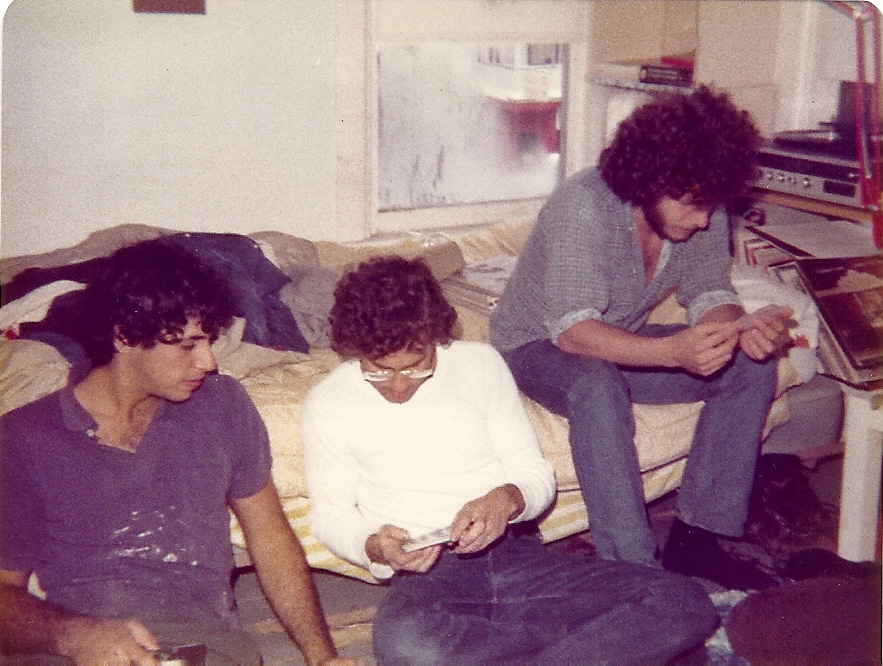
From left, Carl Bass (check out those paint stains!), Geoff Chasin and Herb Sawyer (what a ‘fro!)

On Sunday a friend sent me this link to an article in The New York Times

about one of our friends from Cornell . During college, Carl – that’s his name, Carl Bass – could be seen walking around snowy, freezing streets barefoot with his dog, Charlie, tagging along behind him. When about eight of us lived together in a rundown old barn on Williams Street, he used to go to the computer lab at all hours of the night, feeding slotted papers into a huge machine, talking about computer programming and things that nobody else understood anything about before he dropped out, took off for five years, and then dropped back in again.

I assume he’s now wearing shoes – although the picture in The Times was from the waist up. He was talking about  running his company, Autodesk, and how, as the CEO, he has to stay on course and not keep swerving the bus.

So this is my tool for Tuesday: Don’t swerve the bus.

Let’s take it down a notch to our personal lives. “You’re the one who’s driving the bus,” Carl said. “And if you’re erratic while you’re driving, everyone gets pretty nauseous. It’s really important to be as clear as you possibly can be and not just wake up one day and say we’re going this way and the next day we’re going that way.”

Don’t be afraid to make decisions that people might not like. You can choose what you want to do carefully, but ultimately, put yourself on the line. Get into the driver’s seat. Be willing to risk other people’s disapproval. People often get depressed because they get stuck. They can’t make a decision. They are so worried they might make the wrong one. They get so paralyzed with fear that they’re going to make the wrong choice that they don’t make a choice at all. Look at what is and then act.

Take risks. Don’t hesitate and wonder how Mr. X will react or what Mrs. X will say. If you’re faced with a decision, get out a pen and paper. Draw a line straight down the page. On one side, write, YES. On the other side, write NO. List all your reasons for doing something, no matter how silly they seem. Then list all your reasons for not doing it, no matter how silly they seem. This is your list between you and you. Nobody has to see it if you don’t want. Then count up the reasons. The list that has more items — even if it won’t bring you popularity — is the thing you need to do. Or not.

You can talk it over with a trusted friend but it’s your thoughts that count in the end. Then get on the highway and stay in your lane. Don’t swerve the bus. Keep going. Do whatever it is you feel you must do.

Run in the rain. Get divorced. Stay married. Dye your hair red. Let it turn gray. Wear suspenders. Don’t wear socks. Skip down the street. Sit and watch the birds. Go back to school. Learn tap-dancing. Write a haiku poem – 5 syllables, 7 syllables, 5 syllables – about what you feel right here, right now. Knock on your neighbor’s door and bring her nectarines. Oh, do anything you want but don’t keep swerving the bus back and forth.

Make a decision and stick with it no matter the consequences. You can’t know everything until you get started. And sure, you’ll make mistakes and get knocked down along the way but keep going. Don’t keep trying to get everyone to like you. They’re not going to approve of what you do all the time. But you need to approve of yourself.

Send in your haikus. Send me your thoughts. Don’t be shy! Pick a funny pen name. Be bold. Be the hero of your own life. As I emphasize again and again, especially in this link, To be more you, be less you.

Don’t keep trying to get everyone to like you. They’re not going to approve of what you do all the time. But you need to approve of yourself.

Posted in Be Less You To Be More You, Being a Hero In Your Life, countering depression, Uncategorized | Tagged , , , , , , , , | 2 Comments

Countering Depression, The Dalai Lama, and Carla Bruni-Sarkozy

I was reading a blog the other day in which the blogger wrote how she was depressed and wanted to stay depressed and didn’t want anyone to try to talk her out of it. Readers chimed in saying that they hated the way happy people were so…annoyingly happy.

So when is it comforting to be depressed – and when does that depression slide into murky self-pity? When do we draw the line and say we’ve felt enough sadness, enough is enough? And if so, how do we get out of it?

The first thing is: move a muscle, change a thought. Sitting around will only make us want to sit around some more. Are we genuinely sad about something or do we just have what the French call, le cafard, which literally means a cockroach but also means the blues. (And not just because wonderful Carla Bruni who sings one of my favorite French songs, “Quelqu’un M’a Dit” will no longer be the French First Lady.)

When I start singing the blues, and it lasts a wee bit too long – it feels like an emotional hangover – I have to ask myself, is this something specific or am I just having a pity party? When that happens, I remember my friend Kate who’d set the egg timer for five minutes and say to me, “Aw, go on, have your pity party for another five minutes and then get cracking.”

Sometimes depression borders precariously close to self-pity.

Sometimes I have to remember that it’s surprisingly, paradoxically comforting for me to be depressed, the way I get pleasure from watching sad movies. (Or books – I can read Charlotte’s Web if I want a good cry about losing a friend, and Ethan Frome, if I want a really good cry about doomed love.)

My brain automatically goes into rewind mode and plays something that I don’t think I don’t like thinking about, just to taunt me. In the middle of a yoga stretch, let’s say, I’m zipping back to the time this guy snubbed me in 1986. Or I can remind myself how poorly I acted toward a friend precisely 10 years ago. (I apologized to her, but still.) Is it just me or do you also find yourself rewinding and pressing play again and again on scenes not worth repeating?

I have to train my brain not to wander into that negative neighborhood. Instead, I have to fill my mind with positive thoughts of all I have to be grateful for. And if I stay in the moment and don’t let myself drift backwards, then I’m on contented, solid ground.

Earlier today, I had to apologize to my friend, Lily, because I’d cancelled our work meeting yesterday at the last minute to work on something else. I knew it was wrong – I have a pet peeve about double-booking and there I was doing the same thing – so I knew I had to make my amends.

“I’m sorry about yesterday,” I told her.

“I organized my whole morning around meeting you,” she said with a slighted tone to her voice.

“I won’t do it again,” I said. “I’m really sorry.”

“Never mind,” she told me. “That was like so yesterday.”

Then we both had to laugh.

What do you think about the times you slip into sadness? How do you know when you’re genuinely upset or you just feel like crooning the blues?

This is what the Dalai Lama says on depression:

“On most days the news from Tibet is heartbreaking, and yet none of these challenges gives grounds for giving up. One of the approaches that I personally find useful is to cultivate the thought: If the situation or problem is such that it can be remedied, then there is no need to worry about it…

Then it is clearly more sensible to spend your energy focusing on the solution rather than worrying about the problem. Alternatively, if there is no solution, no possibility of resolution, then there is also no point in being worried about it, because you cannot do anything about it anyway. In that case, the sooner you accept this fact, the easier it will be for you.”

Don’t go wandering in that negative neighborhood. It’s like so yesterday.

Posted in countering depression, Self-care, Self-Talk, Your Best Chapter | Tagged , , , , , , , , , , | 8 Comments

How Not to Go to A Wantologist – Just Read This – It’s For Free

Wow! Did you know there’s a therapist (in California, obviously) specializing in “wantology”? As with any “—ology” from anthropology to zoology, it means the study of something; a wantologist specializes in the study of wants.

So today’s post, with hats off to Arlie Russell Hochschild, author of the upcoming, The Outsourced Life, who wrote an article in today’s The New York Times is how not to go to a wantologist — you just have to continue reading.

Local Museum (Photo credit: filmmaker in japan)

I’m going to tell you how not to pay a wantologist and move closer to your wants than you think.

“What do you want?”

That was the question the wantologist asked her patient as reported by Hochschild. The patient said, “A bigger house.” She was then asked, “How would you feel if you lived in a bigger house?” “‘Peaceful’,” came the reply.”

Now, I’m going to stop a moment and ask you – and myself – the same question. What do you want?

“I want to have a successful blog,” popped my first answer. So then I have to ask myself, How would it make you feel? And I thought, duh, like a success. But what exactly is it that makes me feel successful? When I thought about that question for a moment, I realized that it is this very moment, my fingers moving across the keyboard like prancing dancers (anorexic, perhaps, but still energetic and worth imitating) in the New York City Ballet. Nothing makes me happier than doing this work, right here, right now.

In other words, instead of waiting to get there I can enjoy the moment right here.

What do you want? Do you want to go to Paris to walk around the Louvre? And how would that make you feel? Well, maybe you can’t hop on the plane this week or even next, but maybe you can do something similar. Is it the hush of a museum? Oui? So, is there a local museum near you? Is it browsing in the museum shop? Is it the colors, the art, or the posters you can bring home and hang up on your walls?

Is it the people watching (which I always feel is the most fun about a museum)?

We don’t have to hold out an impossible, improbable goal that is unattainable when there might be much closer goals we can reach. And can we get the feeling another way? For instance, when I wrote that I want to have a successful blog, I also know that I can get that same rush of success entering a running race and crossing the finish line.

Moreover, I have to be patient and do the necessary footwork. I can figure out what I need to do to reach my want and every day make a point to do something, anything, to move closer to my goal. That goes with my philosophy of starting somewhere, which I talked about right here.

But this way of looking at our wants makes us aware the we don’t have to wait to live our best chapter. We can start doing what we like doing today.

We don’t need to pay a wantologist to figure this out. And do you believe that someone was smarter than us and came up with it first? As my friend, Lily, says, “You can’t make this stuff up!”

You can write to me – it’s free. Send your longest wantalogist’s wish list and I bet we can figure it all out. And maybe what you really want is not what you thought you wanted at all. That’s why they say, “Be careful what you wish for.”

About the photo — when I finish each blog, there’s a little bent woman behind the curtain — in my head she resembles my great Aunt Fanny — who then analyzes what I wrote about and suggests certain photos of subjects that are in the public domain and I don’t have to get sued to use them. So, Aunt Fanny came up with that photo of the local museum. It doesn’t look local in my neck of the woods, but she has a creative sense of humor.

Coming up tomorrow: When is it depression – and when is it self-pity? And my tool for Tuesday…stay tuned!

Instead of waiting to get there I can enjoy the moment right here.

Posted in How to Change Your Life, Your Best Chapter | Tagged , , , , , , , , , , | 2 Comments

FiveTips For Writing — And Living — Our Best Chapter

It’s Friday, writer’s workshop day, and today I’ll be talking about the five ways that living our best chapter will help us to write our best chapter – and vice versa. We don’t have to be miserable to write well. Writing — and living — are meant to bring us joy.

1 – “Writing is like driving at night in the fog. You can only see as far as your headlights, but you can make the whole trip that way.”
E.L. Doctorow

I want to see around corners! Both in my life and in my writing. I want to peer past the headlights into the unknown. But we sometimes have to stay in the question. We have to live in the mystery.

In writing, we have to keep going. We might have a vague idea how the plot will go but we have to keep writing, keep moving our hand across the page, keep tapping our on the keyboard. We have to trust that when we get to tomorrow, we will have the tools needed to take care of tomorrow. And when we get to the next page, we will be able to use our imagination and creativity to fill up the blank space.

2 – We can create a whole world for ourselves.

We can use magic. I always think of Harry Potter and as my friend, Joelle, pointed out to me, Harry’s life was magical. Not just the magic wand part but how he overcame being an orphan and living with his cruel aunt and uncle and managed to become a hero. (I still haven’t read the very last book so whatever you do, please don’t tell me what happens. In some ways, I don’t want to find out.)

We must make magic when we write. We can draw from our imagination to create a new scene, a whole world. We can dream up a house we never lived in and describe what it must be like to sit in the rocking chair in the sun room, or lie on a bed with a lumpy mattress on a second floor near where a weeping willow scratches against the window.

In life, too, we can use our imagination to be creative problem solvers.

3 – We don’t know how our story will end.

We don’t know our final chapter. We don’t know how we’re going to die. We don’t know if cancer will eat away our pancreas or we’ll get hit by an SUV or we’ll have a sudden heart attack while playing tennis early one morning in a park where our kids used to play.

If we’re writing well, we’re totally focused in the moment. We don’t know what our characters might suddenly decide to do. In my latest novel, Downturn, one of my characters surprised his wife and did something drastic. He surprised me, too.

Same goes for life. People we love do surprising things beyond our control. The same thing works for the people we create in our heads. Let them all live it up. We don’t want marionettes — unless, of course, we’re putting on a marionette show.

4 – Don’t worry so much about mistakes.

Don’t worry about punctuation in the first round. Don’t worry about grammar. Don’t worry what your mother might think. Don’t worry if your tenth grade teacher said that you were a bad student. Don’t let anyone live rent-free in your head.

Just write. Just write. Just live. Just live. Live and write without any critical voices in your head. Live well, write well. As Natalie Goldberg said, “We are good and therefore we are capable of shining forth…”

Not only in our writing but in our lives. Not only in our lives but in our writing.

5 – I got an email from a writer who had written the first chapter of his novel and was already showing it around and waiting for responses. Maybe he wanted approval to keep going. Maybe he needed outside cheerleaders to get out their pompoms and give him a rah-rah. I told him his writing was good but it was more important that he keeps going. The “good” wasn’t the point. The point was doing the work. I said, “Don’t be worried about the outcome. Just focus on the output.”

He said, “But I want it to be good.”

We have no guarantees that our writing will be good. We have no guarantees that our lives will be good. We can’t keep waiting for the approval, for the guarantee, for the All-OK before we move forward. We have to start somewhere, which is right here, right now, with all we have. We have to write as fast as we can, as much as we can, just like we have to live the best as we can.

And if you do need someone cheering you on when you go deep into that dark cave, where you’re lost and lonely and don’t understand what it is that you’re trying to do, then lean on my belief in you and your creativity, your energy, your resourcefulness. Lean on my belief that each of us is making music to contribute to the whole grand symphony. You must play your part. Nobody else can do that for you except you.

Posted in Writers, Writing, Your Best Chapter | Tagged , , , , , , , , , | Leave a comment

And Now A Word From Dorothy Parker You Could Plotz From

A while ago – a long while ago – I was folding my kids’ clothes and I commented to my first husband, “I’m such a terrible folder.”

More than 20 years later, I remember this because at that moment — as if struck by a bolt of lightning — I became aware that I was constantly putting myself down.

It reminded me of a female comedian (I can’t remember her name) who said, “My boyfriend and I have two things in common: We both love him and hate me.”

Until then, I’d always been lightning-quick with abrasive comments about other people — but even more so, about myself. I was my own worst enemy and I thought putting myself down was clever. Perhaps because I grew up in a house where being sarcastic was the positively ordinary way of speaking. A classic example:

Diana: “Mom, do you love me?”

My Mom: “I have to. Who else could love you?”

I didn’t know that wasn’t regular. I thought the point of talking wasn’t to communicate feelings but to trade barbs. Wasn’t that what intellectuals all aspired toward? I longed to be at the Algonquin Round Table, where writers including Dorothy Parker, Alexander Woollcott, Robert Benchley, and Edna Ferber met for lunch. Parker, in particular, was the goddess of the comeback. She never had a problem with treppenwitz, the perfect comeback line you remember after you’ve already walked down the stairs. She always knew exactly what to say to make you plotz.

“The first thing I do in the morning is to brush my teeth and sharpen my tongue,” Parker said. When Parker was told that Clair Boothe Luce was even kind to her inferiors; Parker replied “Where does she find them?”

It’s wonderful to be witty. But I want to stop shooting myself in the foot – or through the heart. Just like I don’t tolerate people talkin’ ish about my kids, spouse, or friends, I shouldn’t tolerate me talking ish about myself.

This blog post wasn’t what I wanted to write. I actually wanted to write about writing but I’ll save that for my Weekend Writer’s Report (always scheduled for Fridays). But I got an email from my friend, Joelle, that made me think of it. And sometimes, what is so incredible, is that I sit down with my fingers poised above the keyboard like Chopin about to play a sonata (yeah, right) and words I didn’t expect to write start writing themselves. I guess this was what I was meant to say.

Do you allow yourself to be the target of your own bitterness? It’s important to remember that we shouldn’t gossip – even about ourselves. If we want to be a hero in our own lives, then we have to stand up for the little guy. That’s us.

P.S. I also happened to see an article in The New York Times about writers’ best sentences. Not all witty, just beautiful writing. See them here and let me know if you have any other favorite sentences. What is your favorite Dorothy Parker line and why?

Posted in Being a Hero In Your Life, Writers | Tagged , , , , , , , , , , | 3 Comments

“If Only ___ Would Happen, I’d Live My Best Chapter”

How many of us are waiting for conditions to be perfect before we feel that we’re living our best chapter?

I used to think that if I won that Lottery, if I published this book, if I sold that article, if I could go on this trip …then I’d be able to live the life I dreamed of.

I’ve come to understand that many of the things I was waiting for were beyond my control. And more importantly, they were all outside of myself. If I kept waiting and waiting, I’d put off living my life.

I may not have everything I want. But I can take certain steps today to get those things. A flower doesn’t wait for the perfect garden to grow in: it makes that beauty happen. A snail keeps venturing across the path, even if it seems like it’s taking forever, it is still moving forward. We can start that symphony, skip down the street, sing a new song. We can be brilliant, divine and spectacular. We can shine.

“If only’s” are lonely. I don’t have to wait to start doing what I can to make this my best chapter. I can take the smallest step and begin today.

“Life holds so much — so much to be so happy about always,” said Arthur Rubinstein. “Most people ask for happiness on condition. Happiness can be felt only if you don’t set conditions.”

What are you waiting for? What project or goal can you move toward, beginning right where you are, just for today?

Posted in Being a Hero In Your Life, How to Change Your Life, Your Best Chapter | Tagged , , | Leave a comment